

Original price was: $357.00.$99.99Current price is: $99.99.
- Secure Shopping with Safe Payments
- Your questions, our prompt answers.
- Free Shipping Worldwide
- Fast, friendly, always here to help.

About this product
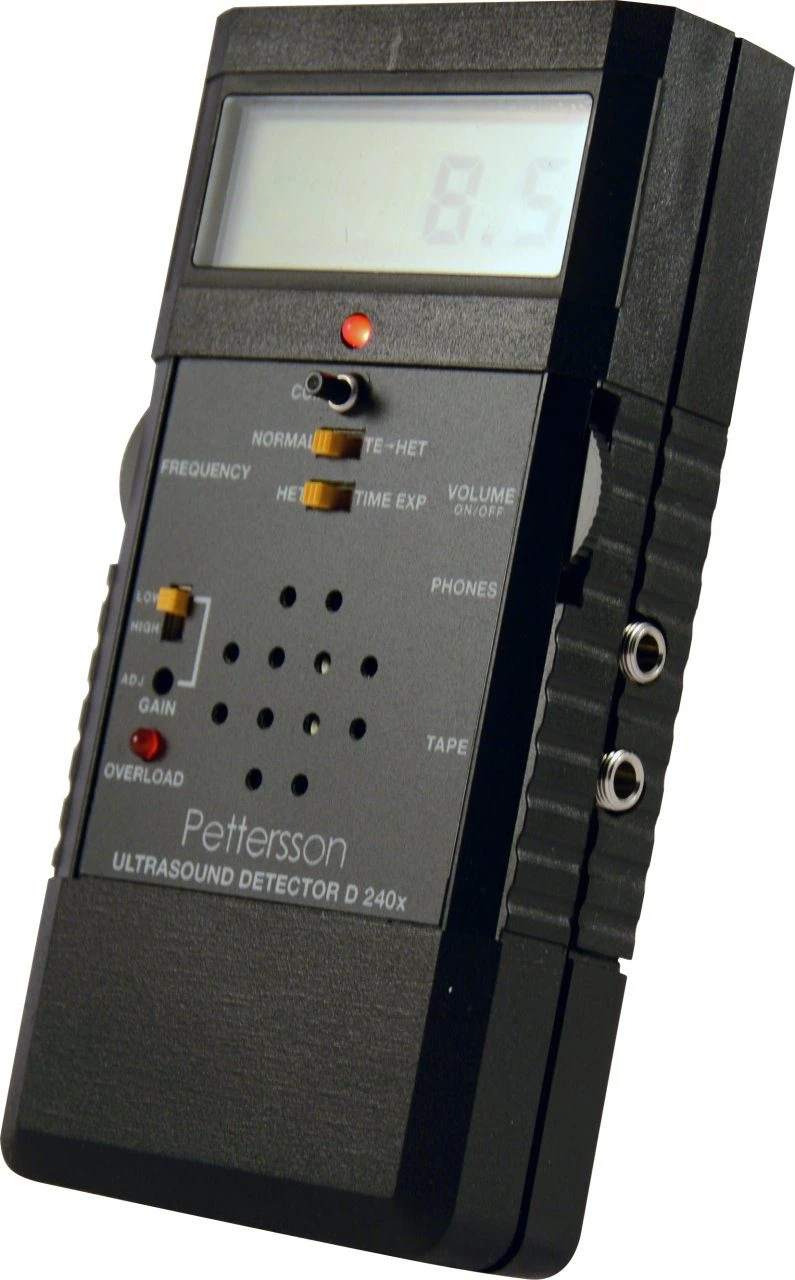
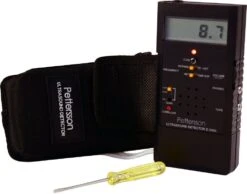
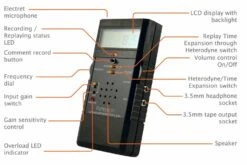
The D240x combines Time Expansion and Heterodyne detection methods allowing detection across all frequencies after which the signal stored in the Time Expansion memory can be replayed at its original rate through the heterodyne system, i.e. the “original” signal can be carefully examined with the heterodyne system.
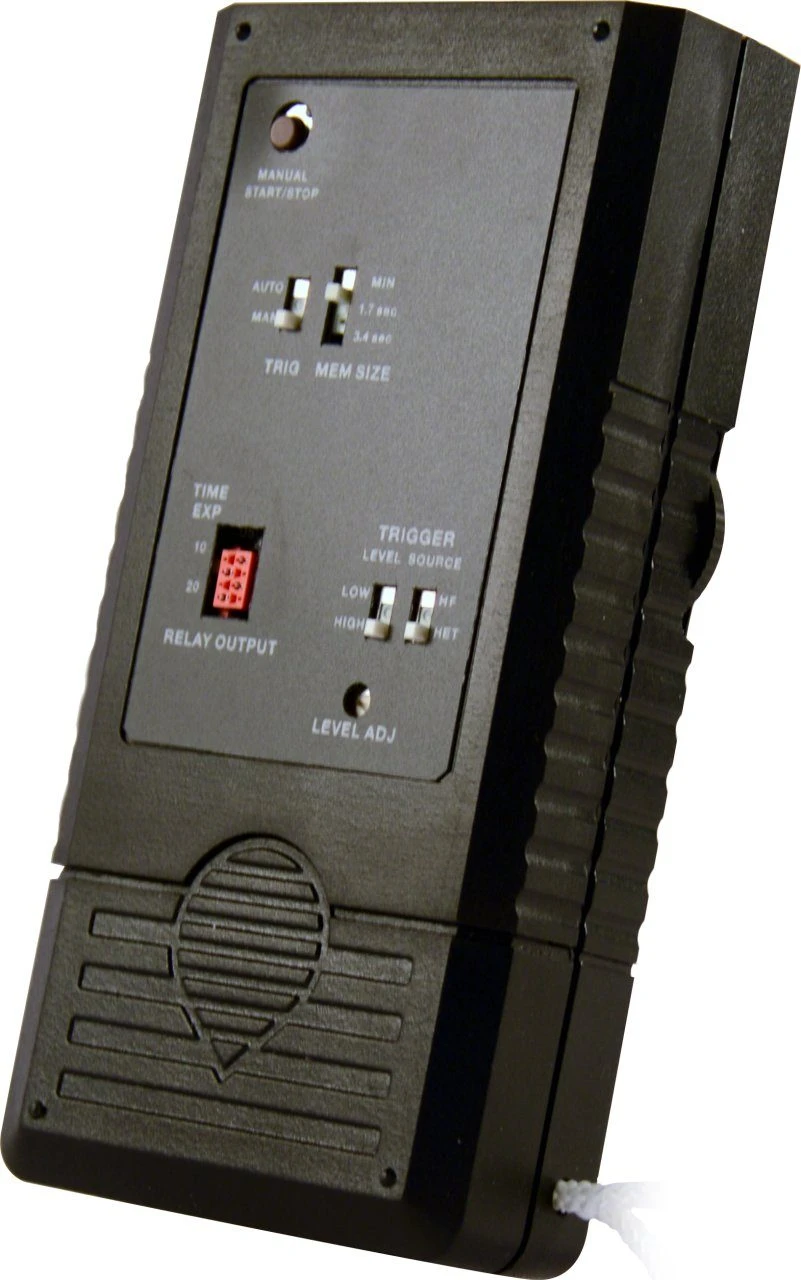
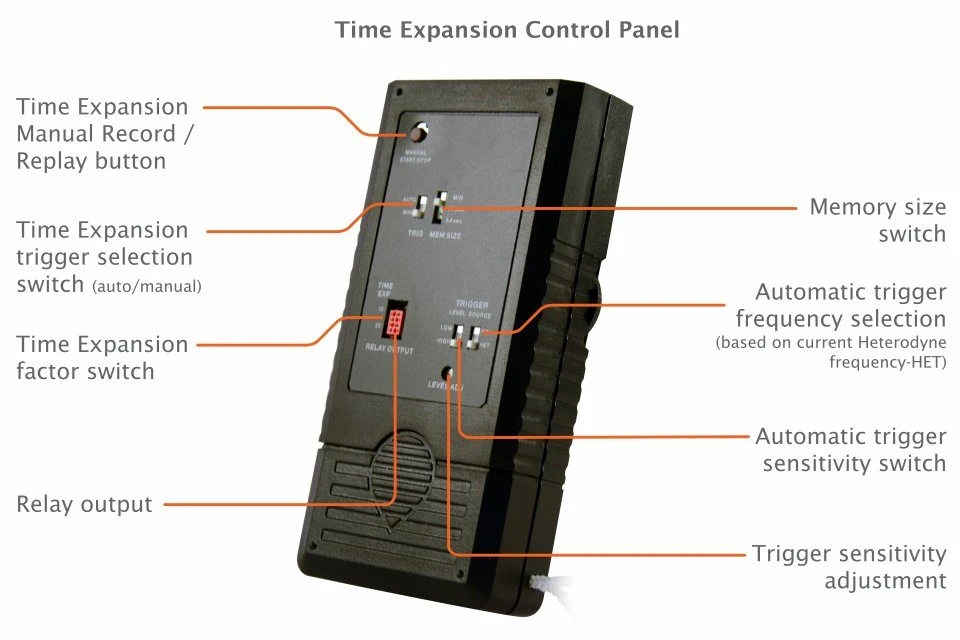
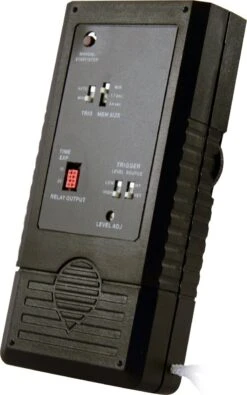
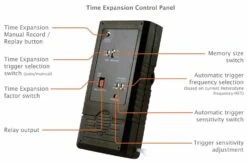
There are both manual and level-sensitive triggering modes allowing this device to be left in-situ (with an external recording device) to automatically record calls remotely using Time Expansion for later analysis. The maximum onboard memory storage time is 3.4 seconds. Via a switch, it is also possible to select a storage time of 1.7 or 0.1 sec.
Heterodyne Heterodyne bat detectors are great for beginners and offer immediate identification of bats in the field. You select the ultrasonic frequency range to listen to just like tuning in radio. Heterodyne detectors typically have a headphone socket and line-out socket for recording calls.
Time Expansion Time Expansion detection is a `broadband’ method as the entire ultrasonic range audible all the time (in contrast to a Heterodyne detector, which is sensitive only to a limited range of frequencies at each time). Time Expansion detectors first stores a portion of the ultrasonic signal in its digital memory and then replays it at a slower speed, i.e. it is does not transform the calls in real time. The delay depends on the actual storage time, and if this is very short (up to around 100 msec), the replay is also made fairly quickly and the detector gives an “almost real time” response. Time expanded calls produce the highest quality sonograms.
Comparing Frequency Division and Time Expansion A Time Expansion detector actually stores the original signal (which is then stretched out in time), The output of such a detector provides the same information as that of the original signal. Hence, it is possible to make any type of analysis and obtain useful and accurate results. This includes spectral analysis of all types (e.g. spectrogram/sonagram).
In contrast a Frequency Division detector counts the number of cycles of the ultrasonic signal and generates an output cycle (pulse) for each N input cycles, where N is often 10. This effectively divides the frequency by N. A Frequency Division detector is only capable of tracking one frequency, consequently, it is not possible to perform any harmonic analysis from an Frequency Division signal. To do this, Time Expansion signals should be used.
Time Expansion detectors have a number of other advantages over Frequency Division detectors. For instance, the former are more sensitive and offer the user better possibilities to aurally analyse the transformed calls. Time Expansion detectors offer the highest quality and most flexible analytical options however, this is also the most expensive detection method and high-end analysis is not required for all applications.
Specification
Type: Heterodyne and time expansion (x10 or x20 – selectable via switch)
Frequency range: 10 – 120 kHz (min.)
Display accuracy: +/- 0.15 kHz
Bandwidth: 8 kHz (+/- 4 kHz), -6dB
Battery: 1 x IEC 6LF22 (9V)
Quiescent current: 30 mA typ. (replay) including LCD backlight
Comment switch: Yes
Memory size: 1M x 8
Sampling frequency: 307 kHz
Resolution: 8 bits
Storage time: 3.4, 1.7 or 0.1 sec. (selectable via switch)
Trigger modes: Manual, level – broadband, level – narrowband
Pretrigger: 50% of the selected storage time
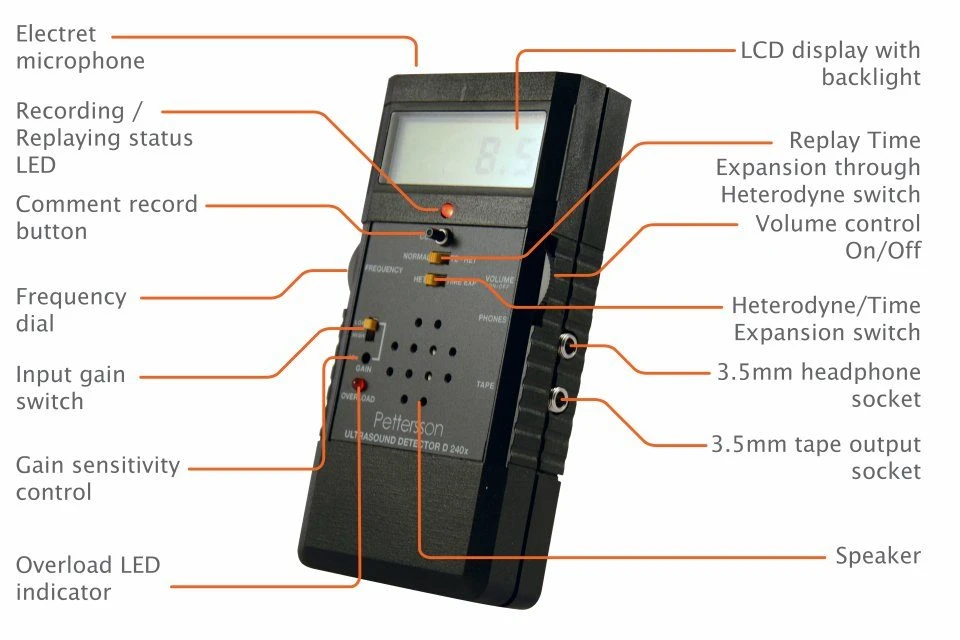
Miscellaneous: Overload indicator, adjustable input gain, replay of signal in memory through heterodyne system, control output for tape recorder
Size: 119 x 60 x 25 mm including knobs
Weight: 170 g. including battery
Outputs: 2 x 3.5 mm jacks for headphones and tape recorder
Be the first to review “Pettersson D-240X Bat Detector”
Related products
Bat Survey & Monitoring
Bat Detector Accessories
Bat Detector Accessories


Bat Handling & Measuring

Bat Survey & Monitoring
Bat Survey & Monitoring
Bat Survey & Monitoring
Bat Detector Accessories
Reviews
There are no reviews yet.